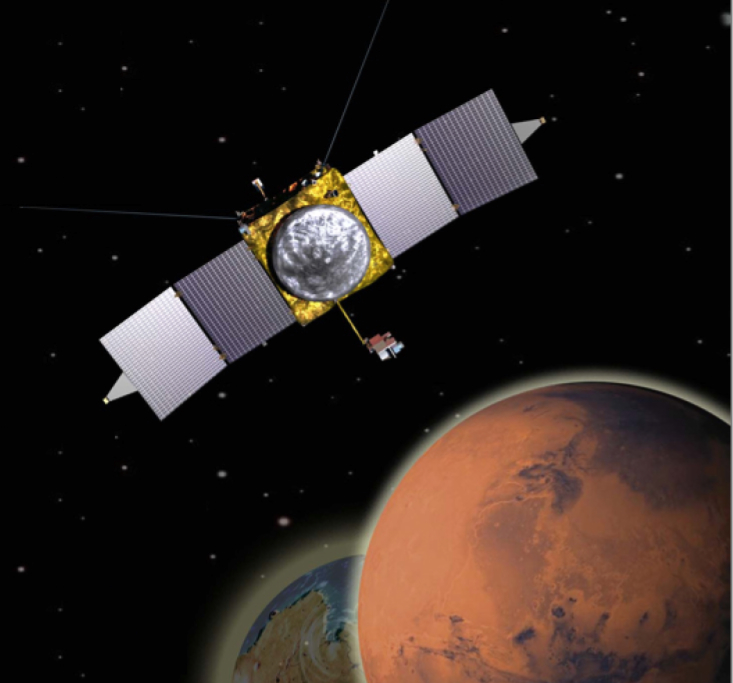
At 1:28 p.m. EST, NASA's Mars Atmosphere and Volatile EvolutioN (MAVEN)
spacecraft launched aboard a United Launch Alliance Atlas V rocket from
Cape Canaveral Air Force Station in Florida, beginning a 10-month
journey to Mars orbit. MAVEN will take critical measurements of the
Martian upper atmosphere to help scientists understand climate change
over the Red Planet's history.
Hip-hop musician will.i.am's "Reach for the Stars" officially became the first song broadcast from Mars today, thanks to a signal beamed from NASA's Curiosity rover.
"This
is the first time that a song's ever come from another planet," Leland
Melvin, NASA's associate administrator for education and a former
astronaut, told students at an educational event at the Jet Propulsion
Laboratory in Pasadena, Calif.
Why they say the sky is the limit When I’ve seen the footprints on the moon Why do they say the sky is the limit When I’ve seen the footprints on the moon And I know the sky might be high But baby it ain’t really that high And I know that Mars might be far But baby it ain’t really that far Let’s reach for the stars Reach for the stars Let’s reach for the stars Reach for the stars Let’s reach for the stars Reach for the stars Let’s reach for the stars (Let, let, let, let me see your hands up) (Let me see your hands up) Can’t nobody hold us back They can’t hold us down They can’t keep us trapped Tie us to the ground Told your people that We don’t mess around When we turn it up Please don’t turn us down We will turn it up Louder than we were before Like the lion out the jungle, you can hear us roar When I lie in here, it’s like a sonic blaster Flying just like NASA, out of space master
Hands up, reach for the sky Hands up, get ‘em up high Hands up, if you really feel alive Live it up, live it up Why they say the sky is the limit When I’ve seen the footprints on the moon Why do they say the sky is the limit When I’ve seen the footprints on the moon And I know the sky might be high But baby it ain’t really that high And I know that Mars might be far But baby it ain’t really that far Let’s reach for the stars Reach for the stars Let’s reach for the stars Reach for the stars Let’s reach for the stars Reach for the stars Let’s reach for the stars Source: Cosmiclog
Curiosity's First Track Marks on Mars. Video: First drive celebration.
Curiosity's First Track Marks on Mars.
This 360-degree panorama shows
evidence of a successful first test drive for NASA's Curiosity rover. On Aug.
22, 2012, the rover made its first move, going forward about 15 feet (4.5
meters), rotating 120 degrees and then reversing about 8 feet (2.5 meters).
Curiosity is about 20 feet (6 meters) from its landing site, now named Bradbury
Landing.
Visible in the image are the rover's first track marks. A small 3.5-inch
(9-centimeter) rock can be seen where the drive began, which engineers say was
partially under one of the rear wheels. Scour marks left by the rover's descent
stage during landing can be seen to the left and right of the wheel tracks. The
lower slopes of Mount Sharp are visible at the top of the picture, near the
center.
This mosaic from the rover's Navigation camera is made up of 23 full-resolution
frames, displayed in a cylindrical projection.
Image
credit: NASA/JPL-Caltech
VIDEO:
Curiosity: First Drive Celebration
Team members celebrate in JPL's Curiosity Surface Mission Support Area when images are received confirming Curiosity's first drive on Mars on Aug. 22, 2012.
Obama calls NASA Curiosity Team: If you find any martian even a microbe, I want to know about it right away.
President Obama Calls Curiosity Team
President Obama phoned the team at JPL on Monday, Aug. 13, to congratulate them on the successful landing of Curiosity. "It's inspiring to all of us. Photographs that are coming back are going to be remarkable and amazing," President Obama said.
"If, in fact, you do make contact with Martians, please let me know right away. I've got a lot of other things on my plate, but I suspect that that would go to the top of the list, even if they're just microbes," he said.
NASA releases video and color photo,of Mars rover landing.
NASA has released a low resolution video of the Curiosity Rover during the final few minutes of its decent to the Martian surface . Video silent.
Curiosity snaps the first color view of the north wall and rim of Gale Crater, where NASA's Mars rover landed Sunday night. The picture was taken by the rover's camera at the end of its stowed robotic arm and appears fuzzy because of dust on the camera's cover.
The color photo from the ancient crater where Curiosity landed showed a pebbly landscape and the rim of Gale Crater off in the distance. Curiosity snapped the photo on the first day on the surface after touching down on Mars Sunday night.
The rover took the shot with a camera at the end of its robotic arm, which remained stowed. The landscape looked fuzzy because the camera's removable cover was coated with dust that kicked up during the descent to the ground.
NASA celebrated the precision landing of a rover on Mars and marveled over the mission's flurry of photographs — grainy, black-and-white images of Martian gravel, a mountain at sunset and, most exciting of all, the spacecraft's plunge through the red planet's atmosphere.
Curiosity, a roving laboratory the size of a compact car, landed right on target late Sunday after an eight-month, 352-million-mile journey. It parked its six wheels about four miles from its ultimate science destination — Mount Sharp, rising from the floor of Gale Crater near the equator.
Extraordinary efforts were needed for the landing because the rover weighs one ton, and the thin Martian atmosphere offers little friction to slow down a spacecraft. Curiosity had to go from 13,000 mph to zero in seven minutes, unfurling a parachute, then firing rockets to brake. In a Hollywood-style finish, cables delicately lowered it to the ground at 2 mph.
At the end of what NASA called "seven minutes of terror," the vehicle settled into place almost perfectly flat in the crater it was aiming for.
"We have ended one phase of the mission much to our enjoyment," mission manager Mike Watkins said. "But another part has just begun."
The nuclear-powered Curiosity will dig into the Martian surface to analyze what's there and hunt for some of the molecular building blocks of life, including carbon.
It won't start moving for a couple of weeks, because all the systems on the $2.5 billion rover have to be checked out. Color photos and panoramas will start coming in the next few days.
But first NASA had to use tiny cameras designed to spot hazards in front of Curiosity's wheels. So early images of gravel and shadows abounded. The pictures were fuzzy, but scientists were delighted.
The photos show "a new Mars we have never seen before," Watkins said. "So every one of those pictures is the most beautiful picture I have ever seen."
In one of the photos from the close-to-the-ground hazard cameras, if you squinted and looked the right way, you could see "a silhouette of Mount Sharp in the setting sun," said an excited John Grotzinger, chief mission scientist from the California Institute of Technology.
A high-resolution camera on the orbiting 7-year-old Mars Reconnaissance Orbiter, flying 211 miles directly above the plummeting Curiosity, snapped a photo of the rover dangling from its parachute about a minute from touchdown. The parachute's design can be made out in the photo.
"It's just mind-boggling to me," said Miguel San Martin, chief engineer for the landing team.
Curiosity is the heaviest piece of machinery NASA has landed on Mars, and the success gave the space agency confidence that it can unload equipment that astronauts may need in a future manned trip to the red planet.
The landing technique was hatched in 1999 in the wake of devastating back-to-back Mars spacecraft losses. Back then, engineers had no clue how to land super-heavy spacecraft. They brainstormed different possibilities, consulting Apollo-era engineers and pilots of heavy-lift helicopters.
"I think its engineering at its finest. What engineers do is they make the impossible possible," said former NASA chief technologist Bobby Braun. "This thing is elegant. People say it looks crazy. Each system was designed for a very specific function."
Because of budget constraints, NASA canceled its joint U.S.-European missions to Mars, scheduled for 2016 and 2018.
"When's the next lander on Mars? The answer to that is nobody knows," Bolden said in a recent interview with The Associated Press.
But if Curiosity finds something interesting, he said, it could spur the public and Congress to provide more money for more Martian exploration. No matter what, he said, Curiosity's mission will help NASA as it tries to send astronauts to Mars by the mid-2030s.
LOS ANGELES (AP) Two months before NASA
is set to land its most sophisticated rover on Mars, engineers on Earth
are busy troubleshooting a nagging concern with the rover's drill that
could contaminate rock samples gathered for study.
Project managers said Monday they were confident the rover nicknamed Curiosity will still be able to achieve its goals despite the hurdle.
For
the past month, a team has been studying ways to get around the
contamination problem, in which flakes of Teflon from the drill can
break off and get mixed in with the rock samples. The effort so far has drained $2 million from the mission's reserve budget.
"It's not a serious problem because we see so many potential ways to work around this," said chief scientist John Grotzinger of the California Institute of Technology.
Curiosity
is on target to land at Gale Crater near the Martian equator in early
August. Instead of relying on airbags to land like previous Mars surface
missions, Curiosity will be lowered to the surface on a tether and fire
its thrusters to touch down. This never-before-tried landing technique
has allowed scientists to zero in on the landing site.
Curiosity
is now slated to land closer to a mountain in the center of the crater,
which will cut down on the amount of driving it will initially need to
do.
Project manager Pete Theisinger of the NASA Jet Propulsion Laboratory estimated this will save about four months of driving, allowing more time to study Martian rocks and soil.
The
two-year, $2.5 billion mission seeks to determine whether the
environment could have been suitable for microbial life. One of the main
goals is to search for the organic building blocks of life using the
most advanced toolkit sent to Mars.
Curiosity is a mobile science
lab. The drill is located at the end of its robotic arm along with a
scoop. It's designed to bore into bedrock and scoop up powdered grains
that are then transferred to Curiosity's deck to analyze.
Tests
before launch revealed Teflon from the drill can rub off and taint the
samples. Some workarounds being considered include baking the samples so
that the contaminant is separated out. The team is also pondering
switching to a different, gentler drilling mode in certain cases.
In
the worst case scenario, scientists may have to rely on the scoop to
collect soil and Curiosity's wheels to crush rocks into bits.
___
Follow Alicia Chang's coverage at http://www.twitter.com/SciWriAlicia .