Axiros has entered a deal with ViaSat, resulting in the
first deployment of the TR-069 protocol over satellite. Under the
agreement, ViaSat will position Axiros’ AXESS.ACS for device management
and provisioning and AXACT TR-069 Stack for integration and execution of
the TR-069 protocol within its satellite modems.
“A cooperation with ViaSat and the extension of the AXESS.ACS and
AXACT products in areas which they were never used before was the most
natural way for Axiros to demonstrate once more to the broadband
community the value of ‘Any device, Any service, Any Protocol, Any
Time, Anywhere,’” said Alfeo Pareschi, senior director technical sales
at Axiros to Via Satellite. “The opportunity to pair together the
wide experience on VSAT communication of ViaSat and the technology
leadership in TR-069 of Axiros will bring an unprecedented amount of
innovation to the Axiros knowledge and product portfolio.”
ViaSat’s decision to partner with Axiros highlights the expansion of
the TR-069 standard beyond terrestrial networks into next generation
satellite networks, according to Axiros. Pareschi added that the
collaboration between the two companies began several months ago and has
transformed from an initial technology exploration, to an extensive
evaluation of the technology by ViaSat and finally to a widespread
design phase to ensure that no part of the ViaSat requirement
specification was undervalued by Axiros.
“We can now safely say that this path has brought both companies to a
much better understanding of the technology challenges inherent on the
deployment of a TR-069 infrastructure over a satellite link,” Pareschi
said. “At the same time the potential advantages in the use of an ACS in
the deployment of broadband over satellite has spun some interesting
innovations in the both companies that are likely to bloom into
additional products and market offering in the next few years.”
For ViaSat, benefits of the deal will enable the company to implement
use cases related to device/service provisioning, dynamic
configuration, information updates, firmware download and scheduled
inform, according to Axiros. Additionally, the deal supports Axiros’
expansion into satellite communications and adds to its growing list of
access networking technologies across which its products are used.
“Axiros has extended the reach of its solution to cover also the M2M
space in general and the Smart Grid in particular. As such the
challenges posed by the ViaSat request has fueled the interest in Axiros
to try to identify and solve the challenges related to the high latency
network. All of this is perfectly in line with Axiros’ Any statement,”
said Pareschi.
Ecuador will enter the list of Space Nations with placing the Pegasus satellite into orbit
La información y el contenido multimedia, publicados por la Agencia de Noticias Andes, son de carácter público, libre y gratuito. Pueden ser reproducidos con la obligatoriedad de citar la fuente.http://www.andes.info.ec/es/node/16032
Beginning this Thursday night and the dawn of Friday, Ecuador will form part of a privileged group in the United Nations—the Space Faring Nations—as soon as it puts in orbit its first satellite constructed completely in the country and by Ecuadorian hands.
The launch of the first satellite, named Ecuadorian Spaceship Pegasus 01 (NEE-01Pegaso) and constructed by the Ecuadorian Civil Space Agency (EXA, Spanish acronym), is scheduled for 11:13 PM local time, this Thursday (04:13 GMT Friday) from the Jiuquan cosmodrome, in China.
This event, of the utmost importance for Ecuador, will be transmitted between 10:30 PM and 11:30 PM on national television and radio channels, and via internet on the website:http://www.earthcam.com/world/ecuador/ecsa/, informó EXA.
During the transmission, one will be able to watch the launch of the Chinese rocket, LM2D (carrier of the satellite), and one can immediately observe through simulations and technical data how the satellite is put into orbit, explained cosmonaut Ronnie Nader Bello, leader of the project.
Náder will command the satellite’s flight operations from the Integrated Security Center ECU-911 in Samborondón, where President Rafael Correa is scheduled to arrive, as well as other State authorities to participate in the historic act.
The National Government, through the National Secretariat of Science, Technology and Innovation (Senescyt), the Coordinate Ministry of Security, and the National Secretariat of Intelligence (Senain, Spanish acronym) have supported this project of the EXA agency.
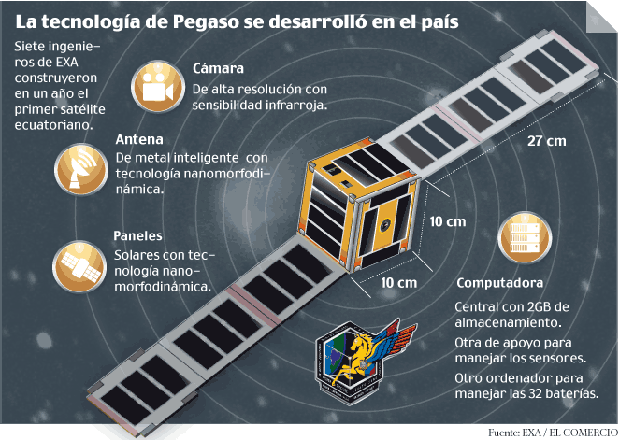
The Pegasus has a cube form, 10 centimeters by 10 centimeters, with 75 centimeter panels and a weight of approximately 1.2 kilograms. It’s calculated to be in orbit until 2018, while the satellite NEE-02 Krysaor, whose launch is scheduled for next August from Russia, will be in orbit until 2025.
The cosmonaut from Guayaquil explains that Pegasus is the first nano-satellite capable of transmitting live video from space, as well as the first of its class to possess a shield capable of resisting solar flares. It’s also the first in its category to carry multiple, foldable solar panels. “It’s the only one in Latin America constructed without foreign help; it’s 100% Ecuadorian and, with pride, carries the phrase Hecho en Ecuador (Made in Ecuador) on its structure, he states.
The satellite was constructed in secret for almost two years with the help of a 60 person team, everyone with at least a PhD in aerospace engineering and a budget of no less than a million dollars—the majority being state resources and a part from private capital.
Náder discloses that it took him at least a year of practice with the terrestrial station, Hermes-A, where he learned to fly more than a dozen satellites, to pass uncountable hours researching, experimenting, and finding errors, to carry out tens of calculations of more than 1,500 variables, to have steady hands to solder components smaller than 1 millimeter, and to have patience to build a printed circuit.
“It took a lot of courage to construct battery banks capable of vaporizing a human being at the first error, to spend hours in a tower 20 meters above the ground, to climb hills on bicycle to do transmission tests, to have an almost demented imagination to find solutions that others would not even dare to imagine, more than 600 hours of tests, a year without sleeping well and, above all else, a lot of Ecuadorian coffee,” highlights the commander in a letter.
The effort, he says, has also included personal sacrifice, limiting family time, “but the prize exceeds that price many times over: We have created the first Ecuadorian satellite.”
For Náder, the feat of entering the list of Space Faring Nations signified that the people have surpassed their adolescence and become adults, because they understood that their survival and independence also depend on their presence in space.
The cosmonaut reveals that the name Pegasus comes from the Greek myth of the flying horse on which the hero, Perseus, gained freedom and progress for his people, but, furthermore, he tells of another more personal reason for having baptized the satellite with that name.
He explains that, as a child, after his mother put him to bed, she would put on a series of animated shows, whose protagonist was Pegasus. “One fine day, they didn’t play the program anymore and I landed here. Years after, when I was 13, again looking at the stars, I dreamed of constructing my own space ship and I swore that, if I achieved it one day, that ship would be called Pegasus.” 40 years later that dream came true for Náder, who said, convinced, that Ecuadorians are capable of achieving many great things.
About EXA
The Ecuadorian Civil Space Agency EXA was founded on November 1st, 2007, in Guayaquil, as an independent, civil organization to administer and carry out the Ecuadorian Civil Space Program, and to develop scientific research in the fields of planet sciences and space sciences.
EXA counts on the endorsement of the Ecuadorian State, through the Ecuadorian Air Force, with which it maintains a narrow relationship.
The Agency operates through its Division of Planetary Sciences, the first and only observatories of ultraviolet radiation in Ecuador, located in Guayaquil and Quito and, through the National Radiation Monitor of UV, reports the levels of ultraviolet radiation that arrive to these cities in real time, thereby providing protection.
Related post:
Ecuador to launch its first satellite "Pegasus". Students desks will become spaceships.
La información y el contenido multimedia, publicados por la Agencia de Noticias Andes, son de carácter público, libre y gratuito. Pueden ser reproducidos con la obligatoriedad de citar la fuente.http://www.andes.info.ec/es/node/16032
La información y el contenido multimedia, publicados por la Agencia de Noticias Andes, son de carácter público, libre y gratuito. Pueden ser reproducidos con la obligatoriedad de citar la fuente.http://www.andes.info.ec/es/node/16032
Video: French wine growers get help using satellite technology.
Wine growers in the south of
France are using satellite technology to observe their vines as they ripen,
leading to targeted harvesting and a higher quality product.
The annual grape harvest has begun in France's
celebrated Chateauneuf-du-Pape wine region. Oenologists like Didier Robert have
high hopes for this year's vintages.
DIDIER ROBERT, OENOLOGIST: "This is a really
pretty white wine from Chateauneuf-du-Pape. Very fruity and with good
freshness. This is the style we are looking for." ... and they're looking
for it from above. A number of French vintners are now using satellite imaging
to ensure optimum quality of the wines they produce. The service, called
Oenoview, scans the terrain and provides computer-generated images, which
indicate variations in the vines and soil type. This helps wine growers gauge
ripeness in different areas of the vineyard so that harvesting happens at the
most favorable time. Cedric Hallereau, manager at the Cooperative Wine
Institute, says it's not just harvesting that benefits, but also pruning and
fertilizing.
CEDRIC HALLEREAU, VINEYARD MANAGER AND WINE-GROWING
CONSULTANT AT THE CO-OPERATIVE WINE INSTITUTE "We can see color
differences which allow us to target our actions in the vineyard, to see what
these different zones have to do with the quality of the grape, to be able to
separate them during the harvest and then also to be able to use this map for
fertilizing, pruning and removing buds and so on." The Fortia Chateau
vineyard in Chateauneuf-du-Pape uses the technology on its entire 31 hectare
estate at a cost of 5,000 euros a year. Manager Pierre Pastre says it's money
well spent.
PIERRE PASTRE, MANAGER OF THE FORTIA CHATEAU IN
CHATEAUNEUF-DU-PAPE: "Thanks to the mapping of this plot, we have been
able to prune quite severely in February/March this year, and just adjusting
the numbers of bunches in June/July by so-called 'green picking'. So now we can
take the benefit to have a very nice bunch of grapes." About 30
wine-growers use Oenoview in France, and the concept is being exported to
Canada, Morocco, Greece and Japan. And soon, sipping a glass of fine wine may
produce a much more predictable finish.
DIDIER ROBERT, OENOLOGIST: "The map will help us
to obtain this result every year because we can choose the right vineyard to
elaborate the right style of wine." ... which for both growers and
consumers adds up to the perfect combination.
Ecuador to launch its first satellite "Pegasus". Students desks
will become spaceships.
Students from the Nuevo Mundo High School, Guayaquil-Ecuador, observe the replica.
The desks
will become spaceships. And from the classroom may experience what feels an
astronaut in space. It's not science fiction.
Pegasus,
the first satellite built 100% in Ecuador, will challenge the magic of
Hollywood and become a direct window to see Earth from the classroom. How will
he do?
A beep
makes the ears tingle. Followed by another scream, similar to a fax.
Disturbingly, almost unbearable. The first is a morse code hiding his name and
that of their creators. The other conveys the image of a winged horse,
surrounded by the tricolor (Ecuador
flag)
The NEE-01
Pegasus is a nanosatellite. It measures 10 by 10 inches, has a cube and weighs
just 1.2 kilograms. In April 2011, after 1000 hours of testing, the Ecuadorian
Civilian Space Agency (EXA) concluded assembly.
This
November 20 will be launched into space on board and take a video camera to
broadcast live from orbit. In space, Pegasus will star Asteria program, a space
platform dedicated to education. Send two signals: the first will contain
questions of science and technology.
The second
image. These signals are decoded by receptadas and Hermes-A earth station
installed by EXA in Guayaquil. And over the Internet will reach young children
and school and college. If a student answers the question successfully access
the camera Pegaso and see the planet from space live, as the astronauts from
NASA.
"We
want to create a generation of Titans in engineering, you see, hear, have
contact with the space and know that this is not Chinese or alien or
otherworldly," says Ronnie Nader, EXA COO. To execute this mission, EXA
outlined a pilot. New World Colleges (Guayaquil), Academia Cotopaxi (Quito) and
Rosa de Jesus Cordero (Cuenca) will be the first to see and apply information
from Pegasus to their curricula. Then join other campuses.
The system
will be similar to the 'A satellite classroom', applied since 2009. Through
this group of children had access, in real time, American satellites NOAA-15,
NOAA-17, NOAA-18 and NOAA-19. They orbit the Earth every 90 minutes. They fly
more than 800 miles high, reporting more than 30 climate variables. Margot
Solberg's second grade teacher at the Academia Cotopaxi. Her students are
between 7 and 8 years and meteorologists are small, able to download and
analyze weather images.
"It's
convenient. Between 2009 and 2010 we obtained data from a drought and the
children learned to anticipate this kind of phenomenon and take precautions.
" The graphics are captured by NOAA satellites. Then fetched by the Hermes
A-Minotaur station, capable of connecting to the Internet permanently outer
space. "We were the first to make that connection. Innocently thought that
earth stations already existed, like in the movies.
But there was no such thing, it was just
another Hollywood glamor, "says Nader. Deputy Minister of
Telecommunications of the Information Society, Ricardo Quiroga, says the
country is preparing to support the millions of downloads of the curious who
want to look out the window of Pegasus. "4 or 5 years ago the country had
just over 1000 miles of fiber optics.
Today we
have over 12,000. That puts us in fiber optic capacity to assume the
technological challenge that emit this signal mean video, live, to everyone
". At 22:00 on 20 November Pegaso take off from a Russian base.
Travel in a
former nuclear missile, along with other 24 satellites of 11 nationalities. The
freight cost USD 500,000 and will be funded by the Government. Two days after
the release of data sent. Astronaut Nader says the first sign will be the
national anthem echoing in the cosmos.
"It
will take about 100 minutes to circle the Earth ... 12:00 when will pass
through Ecuador. "
The Pegaso countdown flashes on the EXA site.
The Friday night missing 95 days, 5 hours, 49 minutes, 5 seconds ... According
to projections EXA, 937 seconds after liftoff Pegaso be ejected into orbit. At
1500 seconds display their antennae, which measure about 45 centimeters. The
orbit of the NEE-01 Pegasus reach 900 km and an inclination of 98 °. Its design
is 50% aluminum and 50% titanium. EXA created a simulation chamber to test
space environment, with temperatures between -198 (frozen air) and 30 degrees.
In Sunday March 25, 2012 the satellite Intelsat 22 was launched.
Intelsat 22 will provide critical C- and Ku-band capacity for customers in Europe, the Middle East, Africa and Asia from its position at 72° east. It also carries an Ultra-High Frequency hosted payload that will be used by the Australian Defence Force. The satellite is the first to utilize Boeing’s new 702MP platform.