Showing posts with label arm. Show all posts

Sunday, October 20, 2019

Samsung, Arm and Synopsis partner to accelerate 5nm SOC development. Press Release.

Imagen relacionada

Synopsys announced recently that the company is partnering with Arm and Samsung's foundry operations (Samsung Foundry) to develop solutions enabling early adoption of the next-generation Arm-based processor.
Design-ready solutions are based on the artificial intelligence (AI)-enhanced, cloud-ready Fusion Design Platform from Synopsys, along with Arm Artisan Physical IP and POP IP for Samsung Foundry's advanced 5LPE process. These solutions will accelerate development of the next wave of semiconductor system-on-chips (SoCs), including designs for high-performance computing (HPC), automotive, 5G, and AI market segments. The collaboration will help customers optimize power, performance and area (PPA), and achieve faster time-to-market while providing full-flow quality-of-results (QoR) and time-to-results (TTR).
"Synopsys' Fusion Design Platform and QuickStart Implementation Kits provide a design-ready solution for next-generation Arm-based processors," said Jaehong Park, executive VP of foundry design platform development at Samsung, in a statement issued by Synopsys. "This is a great example of how Samsung 5LPE technology can be utilized to give designers a competitive advantage in their high-performance CPU designs. Through our close partnership with Arm and Synopsys, customers will now be able to extract maximum value out of our 5-nanometer processes for design applications targeted at high-performance and low-power markets."
Samsung in April 2019 announced its 5nm FinFET process technology is complete in its development and ready for customers' samples. In addition to PPA improvements from 7nm to 5nm, customers can fully leverage Samsung's EUV technology, Samsung noted. The company also disclosed it is working with customers on 6nm, a customized EUV-based process node, and has already received the product tape-out of its first 6nm chip.
Samsung foundry's EUV-based process technologies are currently being manufactured at the S3-line in Hwaseong, Korea. Samsung has plans to expand its EUV capacity to a new EUV line in Hwaseong, which is expected to be completed within the second half of 2019 and start production ramp-up from 2020.

Press Release:
Synopsys, Arm, and Samsung Foundry Enable Accelerated Development of Next-Generation Arm "Hercules" Processor on 5LPE Process
Certified Tools and Reference Flow Enable Early Adopters' Implementation of Advanced Arm Core
Highlights:
  • Samsung Foundry certifies Synopsys' Fusion Design Platform for its 5LPE process with EUV technology
  • Solutions provide PPA gains and enable faster time-to-market
  • QuickStart Implementation Kit (QIK), including scripts and reference guide, available today from Synopsys for Arm advanced core adopters
Synopsys, Inc. (Nasdaq: SNPS) today announced that Synopsys, Arm, and Samsung have actively collaborated on solutions to enable early adoption of the next-generation Arm®-based processor. Design-ready solutions are based on the artificial intelligence (AI)-enhanced, cloud-ready Fusion Design Platform from Synopsys, along with Arm Artisan® Physical IP and POP IP for Samsung Foundry's advanced 5LPE process. These solutions will accelerate development of the next wave of semiconductor system-on-chips (SoCs), including designs for high-performance computing (HPC), automotive, 5G, and AI market segments. The collaboration will help customers optimize power, performance, and area (PPA), and achieve faster time-to-market while providing full-flow quality-of-results (QoR) and time-to-results (TTR).
"To address the pace of innovation in our industry, close collaboration between partners to enable mutual customers is essential," said Paul Williamson, senior vice president and general manager, Client Line of Business, Arm. "The work we're doing with Samsung Foundry and Synopsys on this advanced node enables further optimization to power and performance for next-generation Arm-based devices."
"Synopsys' Fusion Design Platform and QuickStart Implementation Kits provide a design-ready solution for next-generation Arm-based processors," said Jaehong Park, executive vice president of Foundry Design Platform Development at Samsung Electronics. "This is a great example of how Samsung 5LPE technology can be utilized to give designers a competitive advantage in their high-performance CPU designs. Through our close partnership with Arm and Synopsys, customers will now be able to extract maximum value out of our 5-nanometer processes for design applications targeted at high-performance and low-power markets."
Synopsys' Fusion Design Platform has been leveraged for optimized implementation of the new Arm core. The Fusion Design Platform incorporates many Synopsys industry-leading products, including:
  • 7nm and below implementation in Fusion Compiler™ design, Design Compiler® graphical synthesis, and IC Compiler II place-and-route system
  • Higher performance with automatic density control and timing-driven placement
  • Lower power with full-flow concurrent clock and datapath (CCD) optimization
  • Signoff closure with PrimeTime® PBA-based ECO with power recovery and exhaustive PBA along with StarRC simultaneous multi-corner extraction
  • Early, accelerated design optimization for power integrity and reliability with the RedHawk Analysis Fusion signoff-driven flow within IC Compiler II
"Using the latest processors offers early customers the ability to leverage new and innovative technologies for their next-generation products, and to do so, customers need a trusted overall solution to ensure quality-of-results and time-to-market," said Sassine Ghazi, general manager of the Design Group at Synopsys. "This close collaboration among industry leaders paves the way for better and easier implementation, so designers are able to meet aggressive delivery schedules and achieve their performance, power, and area targets."
Availability
QuickStart Implementation Kit (QIKs) for key Arm-based processors are available today at https://www.synopsys.com/arm-opto.

Monday, November 6, 2017

Intel first ARM chips coming by this year`s end.


Intel announced in 2016 a partnership with ARM to make ARM chips using their manufacturing proccess method.

These new chipsets are:

10nm 3.5GHz processor with 10 million transistors in (twice the density of comparable Samsung processor) and consumes only 0.25 mW/Mhz.

A 22nm FinFET ARM chip is also in the works and consumes 30% battery life than comparable 28nm devices.

Intel announced at ARM Tech Con 2017 the availability of them by the end of this year.

Intel will manufacture these chips for selling to OEM companies and is courting Apple for to take away Qualcomm from this business.


Friday, March 24, 2017

ARM DynamIQ is new tech for next gen chips for phones with AI.


ARM, subsidiary of SoftBank, has introduced DynamIQ, a new technology that will lay the foundations of its new generation of processor chips for mobile phone.

The company claims that the aforementioned technology, still undergoing testing, will entail "a huge change in the multi-core microarchitecture industry", and has been developed to meet the demand for ubiquitous AI, autonomous systems and accelerate the Integration of virtual worlds into a combined reality experience. "

ARM ensures that its next generation of chips will work with Cortex-A processors, powered by DynamIQ technology. According to the company, the design will be flexible and versatile, and will allow an easy configuration.

It will also enable manufacturers to establish connections within a wider range of devices, based on a common and secure platform.

In addition, ARM has been able to optimize processors so that "its AI capacity will multiply by 50 over the next 3-5 years," without going into details of what this means exactly.

Thursday, November 7, 2013

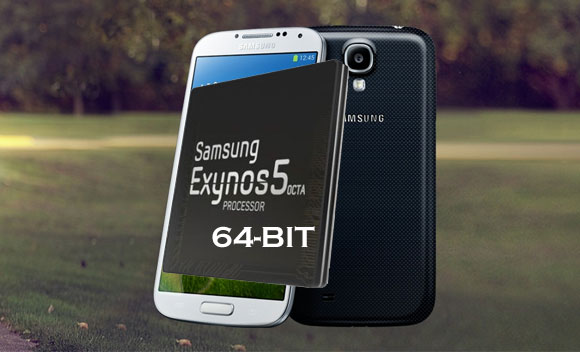
Samsung’s first mobile 64-bit SoC will utilize ARM cores.

Samsung’s first mobile 64-bit SoC will utilize ARM cores.

WorldWide Tech & Science. Francisco De Jesùs.


According to CNET, Stephen Woo, president of System LSI at Samsung Electronics said that Samsung’s first 64-bit SoC will utilize ARM cores rather than Samsung’s own in-house technology.

Why? Samsung sometimes rushes things out to market to perhaps the answer lies there. Woo says Samsung’s follow-up will feature the company’s own 64-bit cores sometime later.

“We are marching on schedule,” the executive said. “We will offer the first 64-bit processor based on ARM’s own core. After that, we will offer an even more optimized 64-bit processor based on our own optimizations.”

Samsung’s upcoming Galaxy S5 and Galaxy Note 4 are both expected to feature the company’s new 64-bit processors when they debut next year.

Samsung fabricates the 64-bit A7 Apple uses in its iPhone 5s and iPad Air, and now it’s working on bumping its own Exynos processors up to 64 bits.

Tuesday, April 3, 2012

ARM, joint ventures with Gemalto and Giesecke & Devrient, to Secure Mobile Payments.

WorldWide Tech & Science. Francisco De Jesús.

ARM,  joint ventures with  Gemalto and Giesecke & Devrient, to Secure Mobile Payments.

ARM, the London-based company that designs the chips in most of the world’s smartphones, announced a partnership on Tuesday with  Gemalto and Giesecke & Devrient, which both make security tools for payment technologies.

They will create technical standards for a “security environment” in an area inside the chip where sensitive data is stored, processed and protected, according to Ben Haber, a spokesman representing ARM.

It means that sensitive data like your credit card information wouldn’t live in the same place as the rest of your data, and you would use payment services inside this secure area as well. This would be invisible to the everyday consumer, but if businesses embrace the standard, it could lead to a steady stream of new mobile payment services.

“The integration of the hardware, software and services necessary for system-wide security has been slow,” Warren East, chief executive of ARM, said in a statement. “I am confident that this new joint venture will accelerate the adoption of a common security standard, enabling a vibrant ecosystem of secure service providers to emerge. This will be a significant step in terms of improved consumer trust in secure transactions on connected devices.”

Source: NYTimes

Monday, October 17, 2011

CubeStormer II solves the Rubik's Cube puzzle faster than the human world record. Using a Samsung Galaxy II.


WorldWide Tech & Science. Francisco De Jesús.


CubeStormer II solves the Rubik's Cube puzzle faster than the human world record.


This ARM Powered robot was designed, built and programmed by Mike Dobson and David Gilday, creators respectively of CubeStormer http://youtu.be/eaRcWB3jwMo and Android Speedcuber http://youtu.be/ylFb4pqAUd8.

The mechanics are constructed entirely from LEGO, including four MINDSTORMS NXT kits, with the addition of a Samsung Galaxy S II smartphone running a custom Android app as the robot's brain. Both the MINDSTORMS NXT kits and the Samsung Galaxy SII use a variety of ARM --based processors.

The app uses the phone's camera to capture images of each face of the Rubik's Cube which it processes to determine the scrambled colours. The solution is found using an advanced two-phase algorithm, originally developed for Speedcuber, enhanced to be multi-threaded to make effective use of the smartphone's dual-core ARM Cortex-A9 1.2GHz processor. The software finds an efficient solution to the puzzle which is optimised specifically for the capabilities of the four-grip mechanism. The app communicates via Bluetooth with software running on the ARM microprocessors in the LEGO NXT Intelligent Bricks which controls the motors driving the robot. During the physical solve, the app uses OpenGL ES on the phone's ARM Mali-400 MP GPU to display a graphical version of the cube being solved in real time.

Human speedcubers' solve times only include the physical manipulation of the cube and don't include some time which is allowed to "inspect" the cube beforehand. Times recorded by CubeStormer II are for the total solve including: image capture, software solution calculation and physical solve.

Want to see it in action?? Check it out at ARM TechCon 2011 in Santa Clara, California Oct 26-27th http://www.armtechcon.com.

Monday, January 24, 2011

IBM and ARM partner on next-gen mobile chips

WorldWideTech & Science. Francisco De Jesús.


Software giant IBM and UK chip designer ARM have joined forces to develop “advanced semiconductor technology” for mobile devices.


 The partnership will focus on developing 14nm chips that use less power but can support “uninterrupted Internet access, high end multimedia and secure transactions.”


IBM and ARM will collaboratively develop design platforms aligning the manufacturing process, microprocessor and physical IP design teams, the two firms said in a statement.


 They claim the collaboration “will minimise the risk and barriers to migrating to smaller geometries while enabling optimised density, performance, power and yield in advanced SoC [System-on-chip] designs,” which will serve to “accelerate the introduction of advanced electronics into the marketplace.”


“ARM’s Cortex processors have become the leadership platform for the majority of smartphones and many other emerging mobile devices,” said Michael Cadigan, general manager, IBM Microelectronics. 


“We plan to continue working closely with ARM and our foundry customers to speed the momentum of ARM technology by delivering highly advanced, low-power semiconductor technology for a variety of new communications and computing devices.”


Last week’s announcement builds on a relationship between the two firms which has been in place since 2008.

Due to previous collaboration on 32nm and 28nm designs, ARM says it has already delivered eleven test chips that provide “concrete research structures and early silicon validation.”

Friday, September 10, 2010

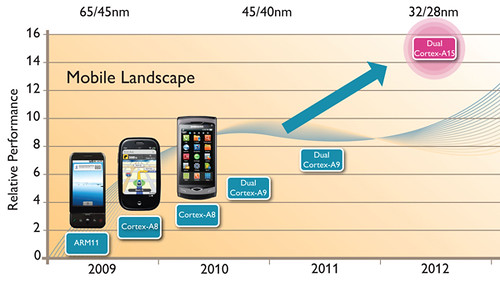
ARM Unleashes Cortex A15 for Smart Phones, Packs up to 8 Cores


ARM is claiming that its new multi-core A15 design will deliver 5 times the performance of current designs, at the same energy as current designs.  (Source: ARM)


The Cortex A15 will join the lower-end Cortex A9 dual-core design to compete with upcoming netbook/smart phone offerings from Intel based on the Atom CPU.  (Source: Intel via Engadget)


Coming soon to an Android phone near you


Smaller, faster, more energy efficient -- those are the goals of ARM's Cortex A15 multi-core CPU.  The processor architectures packs speeds of up to 2.5 GHz and up to four discrete cores, each with the own integer processing unit, floating point processing unit, and L1 cache.  There will be 1, 2, 4, and 8 core variants.

Today the CPU market stands sharply differentiated.  In one corner stands ARM king of the smartphones and energy-efficient proponent of reduced-instruction set computing (RISC).  From iPhones to Androids, most smartphones on the market comes packed with an ARM processor; some come packed with 2 or more.

On the other side of the fence is Intel, whose x86 architecture is the champion of complex instruction set computing (CISC), supporting the market's most powerful CPU designs.

Both groups are eager to take over the other's turf.  With the launch of the Cortex A15, codenamed "Eagle", ARM is not only targeting high power smartphones, but netbooks and potentially notebooks as well.  And with Intel's impending release of an under-1 watt Atom CPU, ARM's rival looks to invade the smartphone market.

On paper ARM's new multi-core processor has some considerable advantages over Intel's Atom.  Atom can only execute two instructions at a time, while Cortex A15 can execute three.  Atom currently can only reach 2.13 GHz (the Intel Atom Z560) -- ARM's Cortex A15 CPU is capable of higher speeds.

The Cortex A15 is also extremely aggressive when it comes to turning off parts of it that are unused.  ARM claims that nearly every part of the CPU is voltage-gated.  However, it takes only 10 µs for the component to go from powered-down to standby, and from standby to active.  Combined, that means that the system should have continue to deliver on ARM's legacy of being more energy efficient that x86 architectures, while not sacrificing performance.

One advantage Intel may have, though, is with memory.  While the Cortex A15 adds extended memory support, for up to 1 TB of total memory, ARM has not announced what kind of memory the chip will support.  Intel has already announced that its upcoming refresh of the Atom CPU will be able to make use of the more efficient DDR3, by contrast.

Like the Atom, the new ARM CPU uses advanced technologies like hardware error checking.  It also brings support for visualization to the ARM lineup for the first time.  Support for fully cache coherent bus protocol -- which allows multi-socket systems -- has also been added for the first time.

The new architecture is slated for production at the 32 nm and 28 nm nodes.

At the moment there's a couple key manufacturers of ARM smartphone processors.  One is Samsung, which makes the CPU core of Apple's proprietary A4 chip found in the most recent iterations of the iPad/iPhone/iPod Touch.  Samsung also make the CPU for the best-selling Galaxy S smartphones.  Another important player is Texas Instruments who makes the processors found in the Droid X/Droid 2 smartphones.

The announcement of the Cortex A15 licensing availability comes just as these players prepare their first dual-core Cortex A9 designs are preparing to hit the market.  Leading the charge will be Samsung 1 GHz Orion CPU and Texas Instruments OMAP4430 (up to 1 GHz)/OMAP4440 (1+ GHz).  Both processors are slated for Q4 2010 launch and Q1 2011

The only player in the smartphone industry who isn't directly licensing the ARM architecture is Qualcomm which uses the ARM's instruction sets (RISC) in its designs, but does not use the architecture itself.  Qualcomm's ARM-like CPU designs are commonly used in HTC's Android smartphones like the HTC EVO 4G.  Qualcomm has already announced that its 1.2 GHz dual-core MSM8260/MSM8660 will be available this quarter and 1.5 GHz QSD8272/QSD8672 variants will be available in Q4 2010.

Expect new designs from TI and Samsung based on the Cortex A15 core to be announced shortly, with mass availability likely set for sometime next year.  And expect Qualcomm to officially unveil its own upcoming quad-core smartphone ARM-instruction set designs soon as well.

Related information: http://worldwidegadget.blogspot.com/2010/09/after-arms-dual-cortex-a9-dual-cortex.html

Thursday, September 9, 2010

After ARM´s Dual Cortex A9 the Dual Cortex A15 is next

ARM this week introduced a new chip architecture called the Cortex-A15 MPCore that the company says delivers a 5x performance improvement over today’s advanced smartphone processors, with a comparable energy footprint.
The multiple core architecture will join the Cortex family of mobile chips that power smartphones, tablets and settop boxes.


The chip, previously code-named Eagle, will be built in 32nm and 28nm processes by IBM, GlobalFoundries and Samsung. Samsung, STMicroelectronics and Texas Instruments are the three ARM partners working on products initially.

Companies like TI and Samsung will make chips that will come in dual and quad core configurations and will run at clock speeds of up to 2.5 GHz. The core is superscalar, capable of running multiple instructions through a pipeline.


The A15 is still a long way from shipping in products. In fact, even its predecessor, the Cortex-A9, isn’t expected to appear until the end of this year.

Earlier this week, Samsung introduced a dual-core 1 GHz Cortex A9-based CPU for tablets, netbooks and smartphones.

Codenamed Orion, the chip features a pair of 1-GHz ARM Cortex A9 cores, each comes with a 32-kbyte data cache and a 32-kbyte instruction cache. It reportedly doubles the Hummingbird’s performance, while improving battery life, allowing 1080p video capability and HD recording. The single core Hummingbird processor powers the Epic 4G and the upcoming Samsung Tab. The Samsung Galaxy S family uses the speedy single core 1 GHz Samsung Hummingbird CPU. Variants of the phone are now available on all four major U.S. carriers.
The next generation Tegra chip features a dual-core ARM Cortex -A9 Processor with an Ultra Low Power NVIDIA Graphics Processing Unit (GPU).
Smartphones and other devices using the Cortex-A15 Processor will go on sale toward the end of 2012, said Eric Schorn, Arm’s vice president of marketing.        

           
Enhanced by Zemanta

Tuesday, September 7, 2010

Samsung Announces Dual-core:The Orion Mobile Processor with two 1GHz ARM Cortex A9 cores

Samsung has announced a dual-core application processor for tablets PCs, netbooks and smartphones that will be able to handle 1080p video playback and recording, the company said on Tuesday.

The Orion processor contains a pair of 1GHz ARM Cortex A9 cores, and its capabilities give a hint at what we can expect from mobile products in 2011.

Besides handling video playback and recording at 1080p and 30 frames per second, a smartphone based on Orion can be equipped with two displays, while at the same driving a third external display such as a TV or a monitor via an HDMI port, according to Samsung.

Samsung is also pushing Orion's graphics performance. With an improved graphics processor, Orion is capable of delivering five times the 3D graphics performance over the previous processor generation from Samsung, which is used on its smartphone Galaxy S and the newly announced Galaxy Tab.

Orion will be available to "select customers in the fourth quarter of 2010" and will go into "mass production in the first half of 2011," according to Samsung.

Samsung isn't the only company working on dual-core processors for smartphones and other smaller portable products, Qualcomm and Texas Instruments are also working on products.

LG OLED evo M5, the Only True Wireless OLED TV With G5’s Excellence in Picture Quality.

  With Uncompromised, Low-Lag Performance at 4K 144Hz, LG’s Advanced Wireless Technology Sets a New Standard for Clutter-Free Gaming and Hom...

Popular Posts